I have been using AI heavily for a couple of years now. The clearest thing I have felt over that time is that its ability to solve hard problems keeps climbing, and the ceiling keeps moving up with each new model underneath it. On a genuinely complex problem, a current top model already does better than most of the undergraduates and graduate students I have worked with.
That leaves an uncomfortable question for anyone raising or teaching a child. If AI can already do the things we spent years training people to do, what is left that is worth teaching?
One answer is easy to rule out. Rote memorization and endless drilling, the whole exam-prep machine, no longer buys much. The facts you grind into memory neither solve real problems nor give you a good way to work with AI. Even hard-won experience and skill matter less than they used to, because AI holds that kind of knowledge more completely, more precisely, and faster than a person can. If you cannot out-remember it and cannot out-practice it, what is actually worth cultivating?
The exam that tests no knowledge
Here is a useful example from an unlikely place: the British 11-plus, the exam children sit around age ten. One of its question types is called Non-Verbal Reasoning. It uses no words and no formulas, only shapes, symbols, and diagrams.
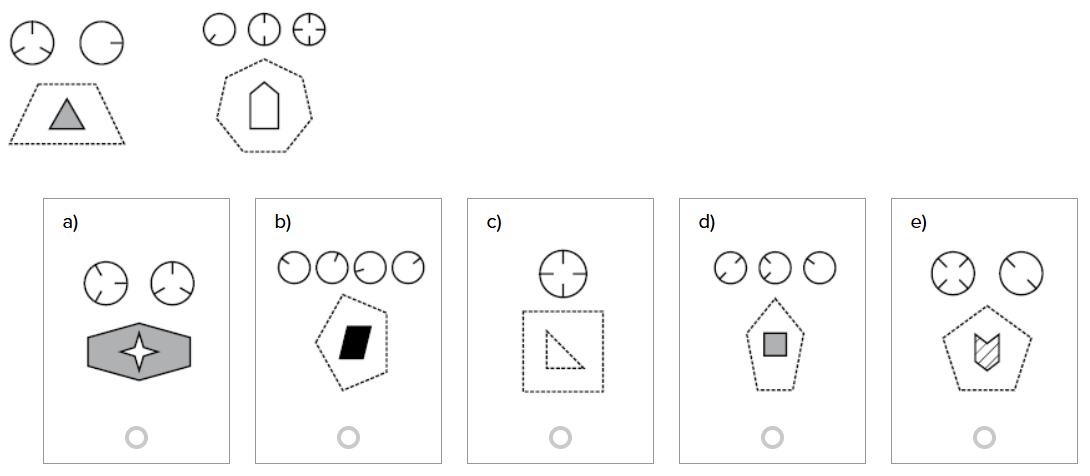
The example above is a similarity question: from five options, pick the one most like the prompt. Whether it is “like” is something you work out for yourself, feature by feature: which way a notch faces, whether an outline is solid or dashed, what shape and shade sits inside. A second type shows a figure changing and asks you to continue the change by the same rule. A third, a coding question, tags each figure with letters that encode its features, and asks you to crack the code: which letter tracks colour, which tracks shape, one variable at a time, until you can label the last figure.
None of these ask you to recall a single fact. What they ask is to look closely, find what the figures share and how they change, mark and tell apart the features, sometimes work out how features relate, then encode and decode them and reason your way to the answer. British test tutors describe the same thing in their own words: pattern recognition, visual comparison by size, orientation and shading, and abstract reasoning.
A chain of thinking, not a stack of facts
Line those abilities up and they form a chain: observe, analyze, generalize, abstract, reason. It runs from concrete seeing at one end to abstract inference at the other, and it leans on none of the things a person can memorize.
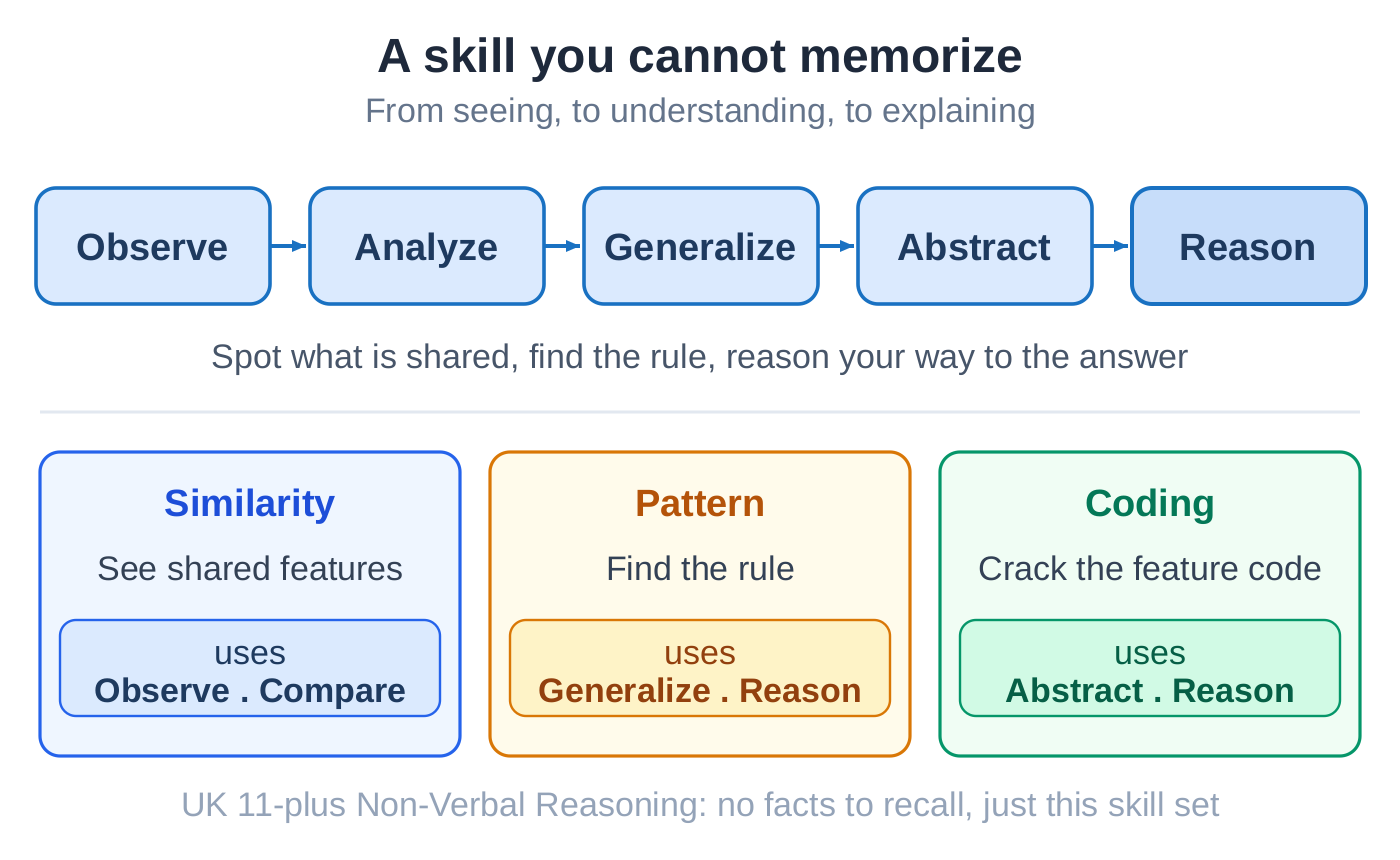
This is worth dwelling on, because it is exactly the part AI does not replace. A model is a strong tool, but it does not go out into the world and notice that something is wrong. It does not, on its own, observe and generalize its way to the real shape of a problem.
Why these skills, now
AI is powerful, and it is passive. It answers when asked. Until you pose the problem and steer it, it sits still, however much it knows.
There is a nice piece of evidence for how much the posing matters. The psychologists Jacob Getzels and Mihaly Csikszentmihalyi followed a group of art students for close to twenty years. They found that what predicted whose work was good was not skill at the drawing itself, but the time spent before the first mark: arranging the objects, turning the problem over, working out what to paint at all. Seven years on, and again eighteen years on, the students who were better at finding the problem were the most successful artists. Many of the pure problem-solvers had left art entirely. Finding a problem carried people further than solving a given one.
The human works the two ends
So in an age of capable AI, a person’s initiative goes to the two ends of the work.
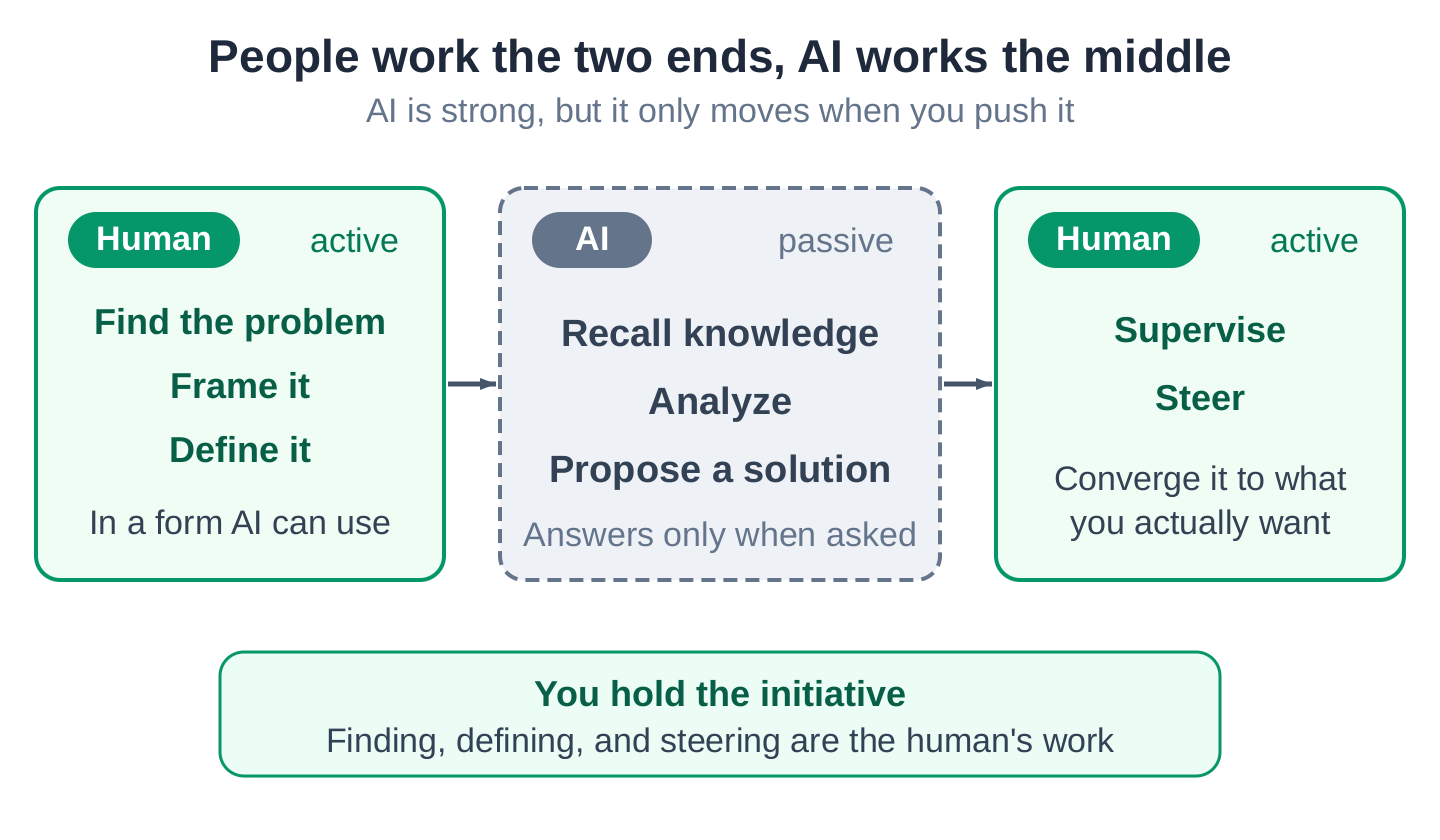
The front end is finding, framing, and defining the problem, then putting it in a form the model can work with. The back end is watching what comes back, steering it, and converging the result to what you actually wanted. The middle, drawing on knowledge and producing a first solution, is where you hand off. This matches what people are settling on about working with AI: the skills that matter are asking a good question, defining the problem cleanly, and being able to see where an answer is wrong or thin. The reflex to hand everything to the model and stop thinking is the one that leaves you led around by it.
And the ground under “ask well, define the problem, judge the answer” is exactly that chain from the exam: observe, analyze, generalize, abstract, reason.
What to cultivate
So, back to the opening question. If AI can do everything, what do we teach?
My answer is to stop pouring effort into remembering faster and calculating more accurately. That ground is lost; the machine has it. What is worth practicing is looking hard at the real world, seeing the shared structure and the rule that others miss, and turning something vague into a problem stated clearly. A test paper may never measure it, and it is the sturdiest thing a person can carry into an age of AI.
Would you rather your child grow up better at solving the problem in front of them, or better at finding the problem worth solving?
Notes
- On what Non-Verbal Reasoning assesses: UK 11-plus tutoring guides (Atom Learning, Keystone Tutors) describe pattern recognition, visual comparison by size, orientation and shading, and abstract reasoning.
- On problem finding: J. W. Getzels and M. Csikszentmihalyi, the long-term study of art students behind The Creative Vision (1976), and Getzels, “Problem Finding and the Enhancement of Creativity” (1985).